
INWP Lender Spotlight: October 2026
Northern Ontario Housing & Mortgage Monthly
For clients in North Bay, Greater Sudbury, Muskoka, Sault Ste. Marie & Timmins — October 2026

Executive Summary - October 2026
Northern Ontario continues to move toward more balanced housing conditions heading into the fall.
Inventory has increased across most markets, sales activity has generally softened, and buyers have more time and negotiating leverage than they did through much of the past few years. At the same time, prices have held up surprisingly well in many Northern Ontario markets.
The material change this month is happening in the interest-rate market. For most of 2026, the Canadian rate story has been fairly uneventful. The Bank of Canada has held its overnight rate at 2.25% since December 2025. That remains the case following its September 2 meeting.
But the conversation is starting to change.
U.S. inflation has moved higher, the Federal Reserve raised rates by 25 basis points in September, energy prices remain an inflation risk and Canadian bond yields moved sharply higher during the month. That does not necessarily mean the Bank of Canada is about to follow the Fed. Canada's economy and employment market are considerably softer. It does mean we can no longer assume that the next meaningful move in Canadian rates will automatically be lower.
Two dates should give us considerably more information: October 19, when Statistics Canada releases September CPI, and October 28, when the Bank of Canada makes its next interest-rate announcement and releases a new Monetary Policy Report.
Market Snapshot
Bank of Canada Overnight Rate: 2.25%
Bank Prime Rate: approximately 4.45%
5-Year Government of Canada Bond Yield: 3.69% as of September 24
Competitive Ontario 5-Year Fixed Rates: approximately 4.29%–4.34% at the low end, with actual pricing dependent on loan-to-value, insurability, amortization and borrower profile
Competitive 5-Year Variable Rates: approximately 3.25%–3.55% for qualifying owner-occupied borrowers, with rental and other non-standard transactions generally priced higher
The most notable change is the bond market. The 5-year Government of Canada benchmark yield began September at approximately 3.35% and reached 3.69% by September 24. That is a meaningful move in less than a month and has already put upward pressure on fixed mortgage pricing.
As of September 26, some of the lowest advertised Ontario 5-year fixed rates were approximately 4.29% insured and 4.34% uninsurable, while average insured 5-year fixed pricing across major banks was closer to 4.86%.
The takeaway is fairly simple: the Bank of Canada does not need to raise its overnight rate for mortgage rates to move higher given the correlation to the bond market.
Interest Rate Outlook
The U.S. Federal Reserve Raised Rates. Is the Bank of Canada Next?
This is probably the most important question for Canadian borrowers heading into October.
On September 16, the U.S. Federal Reserve increased the federal funds target range by 25 basis points to 3.75%–4.00%. It was the Fed's first increase of 2026. The decision came under new Federal Reserve Chairman Kevin Warsh, who took office in May.
Why raise rates now?
Inflation.
U.S. CPI increased 3.4% year-over-year in August, with gasoline prices rising 3.9% during the month and accounting for more than one-third of the monthly CPI increase. The U.S. also has something Canada doesn't currently have to the same extent: a relatively strong employment market. U.S. payroll employment increased by 162,000 in August and unemployment remained at 4.1%. That gives the Federal Reserve more room to fight inflation without immediately putting an already weak labour market under additional pressure.
Canada is in a different position.
Canada's Inflation Problem
Canadian CPI increased 3.0% year-over-year in August, unchanged from July. Transportation costs were up 7.5%, although inflation excluding gasoline was a much more moderate 2.4%. Energy is where things become more complicated.
The Bank of Canada acknowledged in September that the continuing conflict in the Middle East was keeping energy prices elevated. It also pointed to new U.S. tariffs and Canadian countermeasures following the breakdown of trade negotiations between Canada and the United States.
Governor Tiff Macklem has been fairly clear about the challenge. The Bank cannot control global oil prices or undo the economic effects of tariffs. What it can do is prevent those external price increases from becoming embedded in broader Canadian inflation.
The Bank's September deliberations specifically noted that inflation had been above the 2% target for several months and that the risk of inflation spreading to other goods and services had increased.
That is why the October CPI report matters so much.
Two Dates to Watch in October
October 19 - Canadian CPI
Statistics Canada will release September CPI on Monday, October 19. This will be one of the most important pieces of information the Bank receives before its October decision.
If inflation remains around 3%, particularly if underlying inflation remains relatively contained, the Bank has a stronger argument for patience. If we suddenly see inflation move materially higher—particularly if higher energy costs begin feeding into transportation, goods and services—the discussion becomes more difficult.
The headline number will matter, but the composition of inflation may matter even more.
October 28 - Bank of Canada
Nine days later, the Bank of Canada announces its next interest-rate decision. It will also release a new Monetary Policy Report with updated economic and inflation projections. That combination makes October 28 considerably more important than a typical rate announcement.
Why Canada May Not Follow the Fed
The biggest argument against an immediate Canadian rate increase is employment. Canada lost 42,000 jobs in August and the unemployment rate remained at 6.4%. Ontario's unemployment rate was even higher at 6.9%. Compare that with the United States, where unemployment is 4.1%.
Canadian industries that depend heavily on U.S. exports are also operating in an uncertain trade environment following the introduction of additional tariffs. Statistics Canada specifically identified U.S.-dependent industries as facing increased economic uncertainty.
That puts Tiff Macklem and the Bank of Canada in a difficult position. Raise rates too quickly and they risk putting additional pressure on a relatively weak economy. Leave rates too low while inflation accelerates and they risk allowing higher energy and import costs to spread into broader prices.
For now, the Bank is watching both.
Could Canadian Rates Actually Go Higher?
Yes. That risk is more meaningful today than it was a few months ago. But it is important to keep this in perspective. This is not 2022. The last tightening cycle started with the Bank of Canada rate at just 0.25%. It eventually reached 5%. Today we're starting at 2.25%, with a softer Canadian labour market, elevated trade uncertainty and an economy that is considerably more sensitive to higher borrowing costs.
If inflation remains around current levels, the Bank has room to continue holding. If inflation accelerates and higher energy costs spread into the broader economy, modest increases become more plausible. Even in that scenario, however, a future tightening cycle does not necessarily need to resemble 2022–2023.
A move over time from 2.25% toward something like 2.75%, 3.00% or 3.25% would have a very different impact than the nearly five-percentage-point move experienced during the last cycle. For borrowers, the important change is not that dramatically higher rates are inevitable. It's that lower rates are no longer the only scenario worth planning for.
Fixed Mortgage Rates Are Already Moving
This may actually be more important to mortgage borrowers in the near term than the October 28 decision.
The 5-year Government of Canada bond yield moved from 3.35% on September 1 to 3.69% on September 24. Fixed mortgage rates are influenced heavily by bond-market funding costs. So while the Bank of Canada has done absolutely nothing to its overnight rate since December, fixed mortgage rates can—and have—moved independently.
That distinction is becoming increasingly important.
- Variable-rate borrowers should be watching Tiff Macklem and the October 28 Bank of Canada announcement.
- Fixed-rate borrowers should be watching the bond market just as closely.
National and Ontario Market Trends
The broader Northern Ontario story hasn't changed dramatically from our previous reports. Markets continue moving gradually toward balance. There is more inventory. Buyers have more choice. Properties are taking somewhat longer to sell in several markets.
But prices have generally been much more resilient than transaction volumes. That is an important distinction.
North Bay Market Snapshot

North Bay recorded 128 sales in August, down 12.3% year-over-year.
Sales were also 13.6% below the 10-year August average.
The benchmark price was $419,300, still up 1.1% from August 2025.
North Bay also saw a substantial increase in new listings during August, giving buyers considerably more selection.
The market is becoming more balanced, but price data still suggests stability rather than broad distress.
Sudbury Market Snapshot

Sudbury recorded 238 residential sales in August, down 8.1% from August 2025.
Year-to-date sales were down 7.2%.
At the same time, the MLS HPI benchmark price was $499,500, up 1.0% year-over-year. The year-to-date average sale price was $506,305, up 0.5%.
This is a good example of what we're seeing across Northern Ontario: softer transaction activity without a corresponding collapse in prices.
For buyers, there is considerably more opportunity to negotiate than there was when inventory was exceptionally tight.
For sellers, realistic pricing is becoming increasingly important.
Sault Ste. Marie Market Snapshot

Sault Ste. Marie has experienced a more noticeable slowdown.
August sales declined 17.1% year-over-year, and year-to-date sales were down 19.2%.
The benchmark price, however, was $318,300, essentially unchanged from a year earlier at +0.2%.
That disconnect between sales volume and prices is worth watching.
If inventory continues increasing while sales remain weak, sellers may face greater pricing pressure moving forward.
Thunder Bay Market Snapshot

Thunder Bay remains somewhat stronger from a pricing perspective.
Single-detached sales declined 10.3% year-over-year in August, while new listings continued to outpace sales and active inventory increased for a seventh consecutive month.
Despite that additional supply, the overall benchmark price reached $345,100, up 5.9% year-over-year.
The single-family benchmark was $346,800, up 5.7%.
Thunder Bay therefore remains a good reminder that Northern Ontario is not one homogeneous real estate market.
Inventory is increasing across the region, but individual markets are adjusting at different speeds.
The Ontario Backdrop
Northern Ontario's relative price stability also looks more notable when compared with Ontario overall.
Ontario recorded 13,620 residential sales in August, down 6% year-over-year and representing the lowest August sales total in 25 years. The provincial MLS HPI benchmark price was $745,400, down 3.6% year-over-year. Northern markets have generally avoided the degree of price correction experienced in some larger Southern Ontario markets.
Affordability is one reason. Rental fundamentals are another. And in many Northern communities, housing supply remains structurally constrained despite the recent increase in resale inventory.
Rental & Investment Market
The investment market remains more property-specific than it was when financing costs were exceptionally low. Investors can no longer rely on cheap debt to make an average property work. That isn't necessarily a bad thing.
Higher financing costs and slower resale activity are forcing buyers to pay closer attention to the fundamentals:
- What is the actual net operating income?
- Are rents sustainable?
- What do expenses look like after taxes, insurance, utilities, repairs and management?
- What happens to cash flow if financing costs remain elevated?
- Does the property still work without assuming aggressive appreciation?
For good multi-residential properties with strong rental economics, demand remains.
The difference is that investors are becoming much more disciplined about price.
Buyer Takeaway
This continues to be one of the better negotiating environments we've seen in several years.
More inventory and slower sales mean buyers generally have more time to complete proper due diligence and negotiate conditions. The financing side deserves more attention, however. Waiting indefinitely for substantially lower rates is no longer an obvious strategy.
Bond yields have moved higher, the Federal Reserve has started raising rates again and Canadian inflation remains above target. If the right property can be purchased at the right price, negotiating the asset and structuring the financing properly may matter more than trying to perfectly time the interest-rate cycle.
Investor Takeaway
This is a market for disciplined investors. Higher financing costs make leveraged returns more difficult, but softer resale activity can create opportunities to buy better. Underwriting should assume realistic interest rates rather than relying on future rate cuts to make a deal work.
Properties with strong rents, defensible operating expenses and the ability to service debt under conservative assumptions remain attractive. Properties that only work if rates fall or values rise quickly deserve considerably more scrutiny.
Seller Takeaway
Pricing matters more now. Buyers have more alternatives and are becoming increasingly selective.
Well-priced properties in good condition can still attract strong interest, particularly in segments where supply remains limited. But starting substantially above market value and reducing the price later is becoming a more difficult strategy.
The first few weeks of a listing remain important.
Innova Rate Outlook
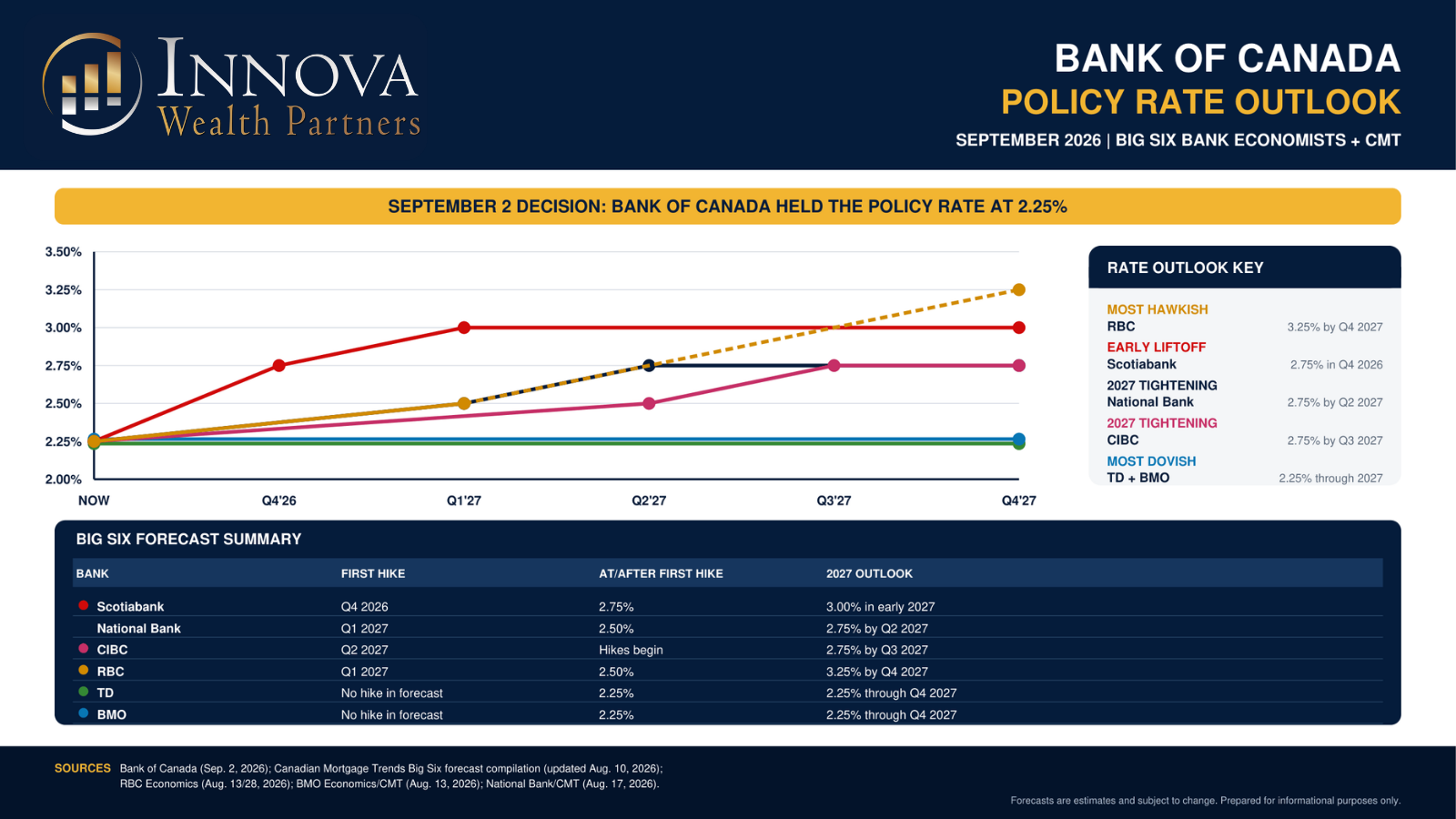
Our base case continues to be that the Bank of Canada can remain at 2.25% in the near term, provided inflation does not accelerate materially. The risk around that outlook, however, has clearly shifted.
Higher energy prices, tariffs and renewed inflation pressures have increased the possibility that the next significant Canadian rate move could eventually be higher rather than lower. At the same time, Canada's weaker employment market and trade-sensitive economy give the Bank good reason to move cautiously. For that reason, we would not assume Canada simply follows the Federal Reserve.
The October 19 CPI report should tell us much more. The October 28 Bank of Canada announcement will tell us how Tiff Macklem and Governing Council are interpreting it. For fixed-rate borrowers, there is a separate issue: the bond market has already moved.
The 5-year Government of Canada yield at 3.69% is materially higher than it was only a few months ago, creating upward pressure on fixed mortgage rates regardless of what the Bank does in October.
Current Outlook:
Near Term: Bank of Canada hold at 2.25% remains a reasonable base case.
Inflation Risk: Increasing, particularly through energy prices and tariffs.
Economic Risk: Canadian employment and trade conditions remain considerably weaker than in the United States.
Fixed Rates: Upward pressure has increased because of higher Government of Canada bond yields.
Variable Rates: Relatively stable unless the Bank of Canada changes its overnight rate.
2027: The range of potential outcomes has widened. Rather than planning exclusively around future cuts, borrowers should be prepared for an environment where rates could remain near current levels or move moderately higher if inflation persists.
Conclusion
For much of 2026, the interest-rate story was fairly boring. That changed in September.
The U.S. Federal Reserve raised rates. U.S. inflation reached 3.4%. Canadian inflation is running at 3.0%. Energy prices remain an upside risk. Canada's 5-year bond yield has moved sharply higher. At the same time, Canada lost 42,000 jobs in August and unemployment remains well above U.S. levels. That leaves the Bank of Canada with a difficult balancing act.
The Bank needs to keep inflation expectations anchored without unnecessarily weakening an economy that is already dealing with trade uncertainty and a softer employment market.
That's why two October dates matter:
- October 19 — Canadian CPI
- October 28 — Bank of Canada Rate Decision
If inflation stays relatively contained, the Bank has room to remain patient. If inflation moves materially higher—particularly if energy-related inflation begins spreading through the broader economy—the possibility of future increases becomes harder to dismiss.
Meanwhile, Northern Ontario real estate continues to offer a fairly constructive backdrop for buyers. Inventory is improving, negotiating conditions are better and prices have generally remained more resilient than sales volumes.
For borrowers and investors, the approach heading into the fall is fairly straightforward: Don't structure a transaction around the assumption that rates are about to fall. Make sure the numbers work today. And maintain enough flexibility to adjust if the rate environment changes.
Sources
Bank of Canada; Statistics Canada; U.S. Federal Reserve; U.S. Bureau of Labor Statistics; Canadian Real Estate Association; Sudbury Real Estate Board; North Bay and Area REALTORS® Association; Sault Ste. Marie Real Estate Board; Thunder Bay Real Estate Board; Ontario Real Estate Association. Market and mortgage-rate information current to late September 2026 and subject to change. Mortgage rates vary by lender, borrower, property, loan-to-value, amortization and insurability.
If you want a personalized renewal, purchase, or investment analysis, just email
Thanks for reading!
Caleb O'Connor, CFP
Partner | Financial Planner | Mortgage & Lending Lead, Innova Wealth Partners
Mortgage Agent Level 1, HomeLink Financial Corp, Brokerage Lic. #10875
📩
This publication is for informational purposes only and shall not be construed to constitute any form of advice. The views expressed are those of the author alone. Opinions expressed are as of the date of this publication and are subject to change without notice and information has been compiled from sources believed to be reliable. This publication has been prepared for general circulation and without regard to the individual financial circumstances and objectives of persons who receive it. You should not act or rely on the information without seeking the advice of the appropriate professional. This report has been prepared by Caleb O'Connor, Financial Planner | Mortgage & Lending Lead, Innova Wealth Partners, for general information and educational purposes only. The information contained in this report is based on sources believed to be reliable; however, accuracy and completeness cannot be guaranteed. Market conditions, interest rates, lender policies, economic data and forecasts are subject to change without notice. The commentary and outlook presented are not intended to constitute individualized financial, investment, tax, legal, accounting or mortgage advice, nor should they be considered a recommendation to buy, sell or finance any particular property or investment. Any forward-looking statements, including expectations regarding interest rates, inflation, economic conditions or real estate markets, are opinions based on information available at the time of publication and actual outcomes may differ materially. Mortgage rates shown are illustrative market indications only and are not a commitment or guarantee of financing. Rates and mortgage terms vary by lender and are subject to borrower qualification, creditworthiness, property type and location, loan-to-value, amortization, insurability and other lender-specific criteria. Mortgage products and services are arranged through the applicable licensed mortgage brokerage. Investment products and services are offered through the appropriately registered dealer and are subject to applicable securities regulation. Insurance products and services are offered through appropriately licensed insurance representatives where applicable. Readers should obtain advice appropriate to their individual circumstances from qualified financial, mortgage, tax, legal and other professional advisors before making financial, investment, borrowing or real estate decisions. Data current to late September 2026 unless otherwise indicated.
- Hits: 699